

Blood Type A
A Positive (A+) and A Negative (A-) are two of the most critical blood types that support patients in our local hospitals. Learn more about type A blood.

A+ Blood Type
A+ is the second most common of the 8 blood types
If you are type A+, your blood can help patients with AB+ and A+ blood types.
Your blood type is ideal for platelet donations. Platelets are needed to stop bleeding — these blood cells collect at the site of an injury and help the blood to clot. You can make a platelet donation every 7 days, and 7 days after a whole blood donation. Most platelet donations help 2-3 patients! Learn more about platelet donation.

A- Blood Type
A- is one of the rarest of the 8 blood types
Only 6% of the population has type A- blood. If you are type A-, your blood can help patients with AB+, AB-, A+, and A- blood types.
Your blood type is ideal for a Super Reds donation. You can donate just red blood cells through an apheresis (ay-fur-ee-sis) donation, a special kind of blood donation that allows a donor to give specific blood components. During an apheresis procedure, all but the needed blood component is returned to the donor.
This Super Reds donation results in twice as many red cells for patients, and it allows you to donate just three times a year with the same impact as donating whole blood six times a year. Give it a try at your next appointment.
Facts and Figures: Type A Blood
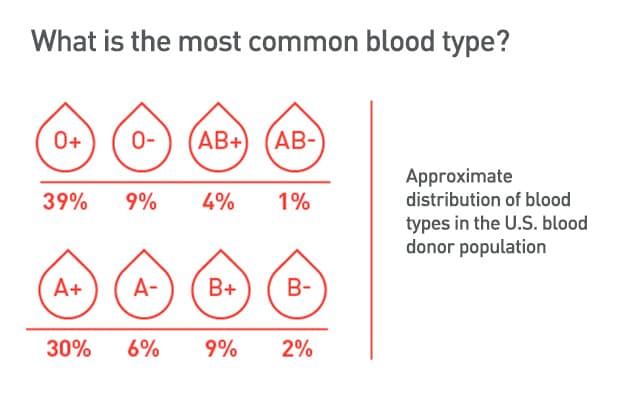
A+ is the second most common blood type, representing 30% of the population. But only 6% of the population have A- blood, which places it among the rarest blood types. Together, 36% of Americans have type A blood.

Only recipients with some combination of the A blood type can receive a transfusion from type A- blood — so, recipients with AB+, AB-, A+, and A- blood types can all receive type A- blood. A+ blood can only be received by those with AB+ or A+ blood.
Common Questions About Type A Blood
What percentage of the population has Type A blood?
Approximately 36% of Americans have Type A blood.
Can people with Type A blood donate to other blood types?
People with Type A blood can donate to other Type A and AB blood recipients.
What are some characteristics of Type A blood in terms of antigens and antibodies?
Type A blood has A antigens on the red blood cells and anti-B antibodies in the plasma.
Are there any specific donation needs for Type A blood?
Yes, there is a continual need for Type A blood donations to ensure a stable blood supply for emergencies and ongoing medical needs in the Pacific Northwest.
What is the difference between A- and A+ blood?
The difference between A- and A+ blood lies in the presence of the Rh factor. A+ blood has the Rh factor, while A- blood does not.
What is special about A+ blood?
A+ blood is one of the most common blood types, making it frequently needed for transfusions and medical procedures.
A+ blood type can receive from which blood types?
People with A+ blood can receive blood from A+, A-, O+, and O- blood types.
How do I know if I'm A+ blood type?
Your blood type will appear in your donor portal account within 48 hours of your first donation. By signing up for an email, you’ll also learn your blood type and which local hospital received your donation.
How can someone with Type A blood make a difference?
By donating blood regularly, individuals with Type A blood can save lives in hospitals across the Pacific Northwest.
Learn About Other Blood Types


